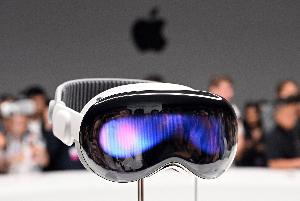
Hey there, tech enthusiasts and Apple aficionados! Buckle up for a wild ride through the rise and fall of the Apple Vision Pro—a $3,500 headset that promised to revolutionize computing but ended up being the tech equivalent of a really expensive paperweight. Let’s dive into how Apple went from “the future is here” to “uh, never mind” faster than you can say “Siri, what went wrong?”
Back in 2023, Tim Cook strutted onto the stage at Apple’s headquarters in Cupertino like a tech prophet, declaring the dawn of “Spatial Computing.” The Apple Vision Pro was unveiled as the next big thing—a headset for your eyes that would supposedly rival the iPhone and Macintosh in terms of world-changing impact. Pre-orders sold out in a blistering 18 minutes, and tech reviewers were practically drooling over the 23 million pixels and sci-fi-level eye-tracking. It was like wearing the future, or at least a very heavy version of it.
Apple had poured a cool $20 billion into this project, hiring thousands of brainiacs across Cupertino, Israel, and beyond. Their R&D budget ballooned from $8 billion to $35 billion by 2023, with the Vision Pro being the shiny star of the show. Tim Cook, usually the supply chain wizard rather than the visionary dreamer, was channeling his inner Steve Jobs, betting big on augmented reality (AR) and virtual reality (VR) as the next wave of computing. He even predicted we’d all be having AR experiences daily, “like eating three meals a day.” Bold words, Tim. Bold words.
At launch, the hype was real. The Vision Pro’s specs were jaw-dropping—custom OLED screens from Sony at $350 a pop, a screen on the outside that tricked people into thinking you weren’t totally zoned out, and a price tag of $3,500, making it the priciest consumer device Apple ever made. Within 10 days, 200,000 units flew off the shelves. Tech bros lined up outside Apple stores like it was 2007 all over again. Social media was buzzing with folks wearing Vision Pros at airports and restaurants, looking like they’d just stepped out of a dystopian movie. Even half of the Fortune 100 companies jumped on board to test it out. Apple seemed poised to dominate yet another market with their classic playbook: wait for others to pioneer, then swoop in with a polished, ecosystem-integrated version.
But then, the cracks started to show—literally, in the form of headaches from wearing what felt like an iPad strapped to your face. Early buyers began returning the headset, citing a critical flaw: they couldn’t figure out what to actually do with it. Unlike the iPhone, which thrives on a million apps, the Vision Pro launched with just 600 apps on its Vision OS. Big players like Netflix, YouTube, and Facebook didn’t bother building for it. By mid-2025, the app count crept up to 3,000—cute, but a far cry from the iPhone’s millions. Turns out, a fancy headset is only as good as the stuff you can run on it.
The numbers painted an even grimmer picture. In 2024, Apple sold 390,000 Vision Pros—a rounding error compared to the 220 million iPhones sold that year. At $3,500 a pop, with production costs estimated at $2,000 per unit, the economics were a disaster. By Q4 2025, production was slashed, marketing budgets were cut by 95%, and only 45,000 units sold. To put that in perspective, some Best Buys sell more phones during a holiday weekend. Ouch.
While Apple was busy trying to convince us that a heavy, isolating headset was the future, they missed the real tech wave crashing over everyone else: artificial intelligence. In 2022, OpenAI dropped ChatGPT, which hit 100 million users faster than any product in history. Apple wasn’t alone in missing the boat—Meta, Google, and Microsoft scrambled too—but Apple’s laser focus on VR meant they were caught especially flat-footed. Their AI chief even dismissed chatbots as useless, while Siri remained the butt of tech jokes (most of us have it turned off, right?). By 2024, Apple was in catch-up mode, demoing a fake “Apple Intelligence” that didn’t exist. The ultimate humiliation? Licensing Google’s AI engine, Gemini, to power Siri in 2025. Talk about eating humble pie from your biggest rival.
Meanwhile, the Vision Pro team was dismantled. Mike Rockwell, the star hired to lead the project, was reassigned to fix Siri and get Apple back in the AI game. Plans for a lighter “Vision Air” were scrapped. Meta, on the other hand, figured out what people actually wanted in AR: lightweight Ray-Ban smart glasses that enhance real life, not isolate you from it. I’ve got a pair myself, and they’re a far cry from a $3,500 face brick. Meta learned that tech sells when it connects us, not when it locks us in a virtual bubble. Apple learned that lesson the hard way.
So, what’s the takeaway from this $20 billion misstep? Apple stuck to their trusty playbook—be a fast follower, enter an established market, and dominate with a better product. It worked for iPods, iPhones, and Apple Watches because those were things people already wanted. But with the Vision Pro, they built a better version of something nobody asked for. It’s a reminder to question your assumptions, even if you’re a trillion-dollar company—or just a regular Joe with a business idea. Passion is great, but when it blinds you to reality, you end up with a headset that’s more museum piece than must-have.